They Found a Bulging Disc on My MRI — Is That What's Causing the Pain?
MRI findings like bulges, stenosis, and herniated discs also exist in healthy people with no pain at all. On the loose link between imaging findings and chronic pain.
Here's a true story — a patient came in with chronic low back pain radiating into his left leg, and mentioned he'd been diagnosed by MRI with a herniated disc in his back pressing on a nerve at the L5–S1 level.
Let me explain briefly: when significant pressure is placed on a nerve root in the back (for example, from a herniated disc), pain can be referred down that nerve — that is, down the leg on the same side as the herniation.
When I asked to see the MRI report, I saw that he was both right and wrong. Right, because there really was a herniated disc pressing on a nerve root — but wrong, because the pressure was on the right side (!) of his back only (not the left side, where he felt the pain). When I asked whether his right leg hurt, he said no — "only the left."
This example points to two very important phenomena:
- You can have a herniated disc without pain.
- You can have pain without a herniated disc.
How Does That Make Sense?
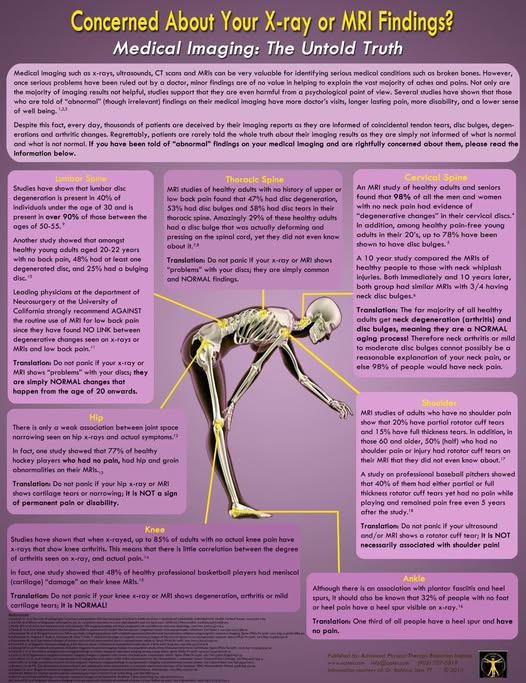
Well, for many years now, studies have shown that even healthy people who don't suffer from pain have plenty of findings on imaging (MRI, CT, ultrasound, X-ray).
For instance, a large review of such studies found that at age 30, about 30%–50% of people with no pain have "degenerative changes," bulges, and herniated discs in the neck and back. By age 50 this already appears in 50%–80% of the healthy population, and by age 80 in about 80%–96% [1].
It's important to understand — these are people who don't suffer from pain. They have bulges, herniations, stenosis, and wear-and-tear changes, and they have no idea. It doesn't bother them. It's there, it's real, but it isn't causing pain!
Similar evidence has been found in other joints too: neck, shoulder, elbow, knees, ankles. Findings like tendon tears or calcifications, cartilage wear, meniscus tears, labral tears, "bone spurs" and more all exist in healthy people who have no pain (!).
It's worth saying — there are a number of findings that can appear on a scan and can explain long-standing pain, but it's important to know they're very rare, and in the vast majority of cases a competent doctor can rule them out with a physical exam and a short interview.
On top of that, if I injured my shoulder and felt a sharp pain, and a scan showed a tear, there's a fair chance that the tear really is causing the pain. But that isn't the case in most chronic pain situations.
Why? Because over time the human body knows how to repair damage, create compensations, and lower the level of pain even if the injury hasn't fully disappeared (think of scars, which stay in the body for life but don't cause pain — the same thing can happen "on the inside").
In fact, the prevalence of those MRI findings rises with age, yet pain is not more common in older age. Just as our hair turns white and our skin wrinkles over the years, so do our internal tissues change — and that's normal!
There's even evidence that herniated discs are reabsorbed over time in 66% of cases, and disappear [2]. And disc bulges / degenerative changes — they were probably there before the pain, and will remain after it passes.
Pain is a brain phenomenon tied to unconscious brain activity, which may begin with tissue injury but, in the vast majority of cases, over time becomes disconnected from it.
And what about that aching patient from the start of the article? After a few sessions his pain dropped considerably, and disappeared within a few weeks (the herniated disc is still there, I believe…).
In the next article I'll take on some common myths about chronic pain, such as whether it's caused by bad posture? Overloading? Weak muscles? Weather changes? (Hint — not exactly…).
Sources:
- Brinjikji et al, (2015). https://doi.org/10.3174/ajnr.A4173
- Zhong et al, (2017). Pain Physician. https://pubmed.ncbi.nlm.nih.gov/28072796/
Disclaimer: The information in this article is for general knowledge only. It is not personal medical advice and is not a substitute for it. If you have any health problem, please consult a qualified health professional to evaluate it.